A simple prayer can become the doorway to new habits: Lord, I cannot change myself. But You can change me. Start with my desires. Shape my will. Strengthen my steps.
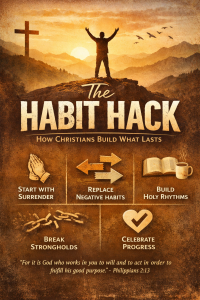
2. Replace, Don’t Just Remove
Bad habits rarely disappear by accident. They have to be replaced with something stronger. Jesus taught this principle when He said that an empty, swept house can be reoccupied by worse things if nothing new fills it (Matthew 12:43–45).
If you want to break a destructive pattern, you need a holy pattern to take its place.
- Replace mindless scrolling with Scripture meditation.
- Replace complaining with gratitude.
- Replace isolation with community.
- Replace impulsive reactions with prayerful pauses.
Galatians 5:16 gives the secret: “Walk by the Spirit, and you will not gratify the desires of the flesh.” Notice the order. You don’t stop the flesh first. You start walking with the Spirit, and the flesh loses its grip.
3. Build Rhythms That Invite God In
Good habits aren’t just routines. They’re rhythms that make room for God.
David said, “Evening, morning and noon I cry out in distress, and he hears my voice” (Psalm 55:17). Daniel prayed three times a day. Jesus withdrew regularly to quiet places. Scripture shows a pattern: holy habits anchor the heart.
Here are rhythms that strengthen your walk:
- Morning Scripture intake to set your mind.
- Midday prayer to recenter your heart.
- Evening reflection to review your day with God.
These aren’t boxes to check. They’re invitations to stay connected to the One who changes you from the inside out.
4. Let God Confront What Holds You Back
Some habits aren’t just unhealthy. They’re spiritual strongholds. And strongholds don’t fall politely. They fall when confronted.
Second Corinthians 10:4 says, “The weapons of our warfare are not carnal, but mighty through God to the pulling down of strongholds.”
There are moments when God speaks clearly and firmly to the things that have held you hostage. Moments when He says, “Throw that down.” Throw down the bitterness. Throw down the secret sin. Throw down the compromise. Throw down the distraction that keeps stealing your focus.
This isn’t condemnation. It’s liberation. God confronts what keeps you from Him because He wants you free.
5. Celebrate Progress, Not Perfection
Habits grow slowly. Faithfulness is built one small step at a time. Scripture reminds us, “Do not despise these small beginnings, for the Lord rejoices to see the work begin” (Zechariah 4:10).
Every time you choose obedience, even in small ways, heaven celebrates. Every time you turn away from an old pattern, you’re declaring that God is forming something new in you. Every time you show up again after a setback, you’re proving that grace is stronger than failure.
Closing Thought
Good habits don’t make you holy. But they make room for the Holy One to shape you. Bad habits don’t disqualify you. They simply reveal where God wants to bring healing.
Lean on Him. Walk with Him. Let His Spirit strengthen what is weak and uproot what is harmful.
Because when God gets involved in your habits, your habits become highways for transformation.

 Every one of us knows what it feels like to wrestle with habits. Some we wish we could break. Some we wish we could build. And somewhere in the middle is that tension between who we are today and who we know God is calling us to become.