How Compounding Works in Real Life
A bad financial decision leads to stress. Stress leads to poor sleep. Poor sleep leads to emotional reactivity. Emotional reactivity leads to relational conflict. Conflict leads to isolation. Isolation leads to destructive coping mechanisms. And destructive coping leads to even worse decisions.
It’s the same principle Jesus described when He said, “Whoever can be trusted with very little can also be trusted with much, and whoever is dishonest with very little will also be dishonest with much” (Luke 16:10, NIV). Small patterns—good or bad—grow into defining habits. The compounding effect is real: each decision makes the next one easier to justify and harder to resist.
Poor Circumstances Accelerate the Damage
Compound interest grows fastest under the right conditions—steady deposits, consistent time, and stability. Compounding stupid decisions thrive under the opposite: exhaustion, discouragement, loneliness, anger, or fear. When we’re already vulnerable, the “interest rate” on bad choices skyrockets.
That’s why Scripture urges us to guard our hearts: “Above all else, guard your heart, for everything you do flows from it” (Proverbs 4:23, NIV). When our hearts are weary or wounded, our judgment falters. A decision that might have been minor in a healthy season can become devastating in a broken one.
Why We Don’t Notice Until It’s Too Late
Compounding is subtle. You don’t feel the damage immediately. You feel it when the accumulation finally breaks something—a relationship, a reputation, a career, or your peace. The Apostle Paul cautioned believers, “Do not be deceived: God cannot be mocked. A man reaps what he sows” (Galatians 6:7, NIV). The harvest always comes, whether we sow wisdom or foolishness.
By the time we realize what’s happening, the momentum is already working against us. That’s the danger: compounding stupid decisions feel harmless until they aren’t.
The Good News: You Can Reverse the Curve
The same principle that multiplies bad decisions can multiply good ones. One wise choice—just one—can interrupt the cycle. Asking for help. Telling the truth. Setting a boundary. Choosing humility. Pausing instead of reacting. Walking away instead of escalating. Admitting, “I don’t trust myself right now.”
God specializes in redemption. “If any of you lacks wisdom, you should ask God, who gives generously to all without finding fault” (James 1:5, NIV). One prayer, one act of obedience, one moment of surrender can change the trajectory. Good decisions compound too—they rebuild clarity, restore confidence, and create stability. They make the next good decision easier.
You don’t have to fix everything at once. You just have to stop feeding the compounding machine.
Final Thought
Compound interest rewards consistency. Compounding stupid decisions punishes it. The trajectory of your life is shaped less by the size of your choices and more by the pattern of them. Break the pattern, and you break the power. Build a new pattern, and you build a new future.
As Proverbs 3:5–6 reminds us: “Trust in the Lord with all your heart and lean not on your own understanding; in all your ways submit to Him, and He will make your paths straight.”
When you trust God’s wisdom over your own impulses, the compounding begins to work in your favor—and grace becomes the interest that never stops growing.

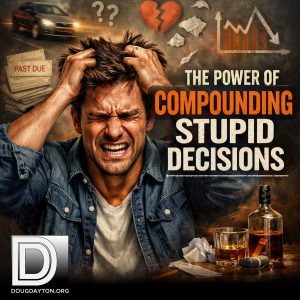 We’ve all heard about the miracle of compound interest—how small, consistent investments grow exponentially over time. It’s one of the most powerful forces in finance. But there’s a sobering parallel in life: stupid decisions compound too. When we repeatedly make choices rooted in poor judgment or unhealthy circumstances, the negative impact doesn’t just add up—it multiplies.